General – Floating Wind
Spanish engineering firm ESTEYCO is preparing to deploy its innovative WHEEL floating wind turbine platform at the PLOCAN offshore test site in the Canary Islands.
This marks a significant milestone in the evolution of floating offshore wind technology. Installation and commissioning of the 6 MW, two-bladed turbine are scheduled for the winter of 2026–2027.
First conceived in 2014, the WHEEL project aims to tackle one of the sector’s most enduring technical hurdles: the installation complexity associated with conventional SPAR floating foundations. Traditional SPAR platforms typically require deep-water ports and extensive offshore assembly operations, limiting deployment flexibility and increasing costs.
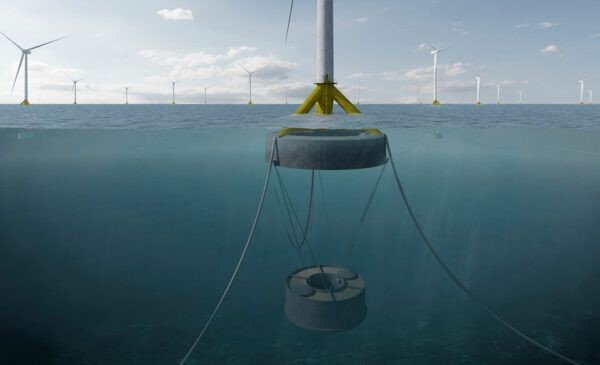
ESTEYCO’s solution centers on a two-part concrete ring structure consisting of an upper buoyancy tank and a lower ballast tank. During transport, the two sections nest together, enabling the platform to operate as a shallow-draft barge while in port. This configuration allows the complete turbine assembly to take place quayside without the need for specialized port infrastructure.
Once offshore and in deep water, the lower ballast tank is gradually submerged through a controlled ballasting process, transforming the unit from a transport barge into a fully operational SPAR platform.
According to the consortium, the design can reduce tower steel requirements by as much as 40% compared with comparable semi-submersible floating wind concepts.
The WHEEL initiative is backed by the European Commission under the Horizon Europe program with total funding of €25.3 million. The eleven-member consortium includes major industry players such as EnBW, Boskalis, and Cemex, with ESTEYCO serving as project coordinator.
