Wind Energy – Baltic Sea
The expansion of the grid connection systems for connecting offshore wind farms in the Baltic Sea is progressing well.
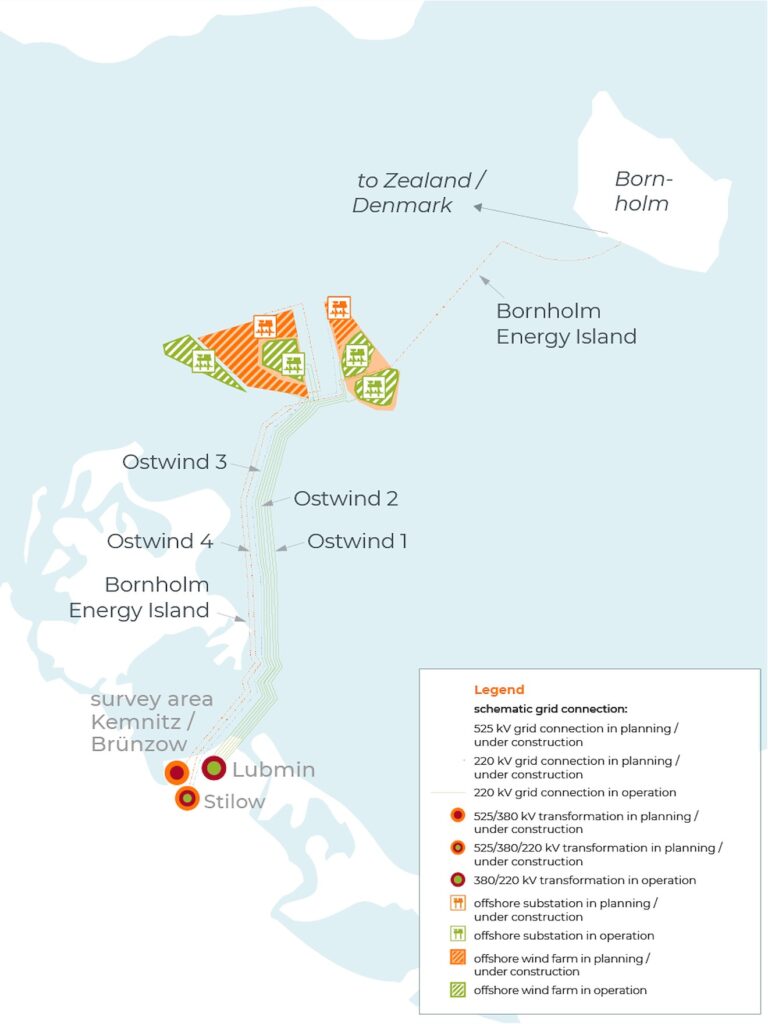
40 kilometres northeast of the island of Rügen, an important stage in the 50Hertz Ostwind 3 project has now been completed – the installation of the Jasmund offshore platform.
It is to collect 300 megawatts from the Windanker wind farm from October, transform it to the voltage level of 220 kilovolts and transmit the electricity via a submarine land cable connection to the new Stilow substation in the Vorpommern-Greifswald district, which is still under construction.
Stefan Kapferer, Chairman of the Management Board of 50Hertz: “After Ostwind 1 and 2, Ostwind 3 is the next project in the sea area northeast of Rügen, which we will complete on time and within budget. We are also on track with the next OST-6-1 project with a transmission capacity of 927 MW, which serves to connect the Gennaker wind farm north of the Fischland-Darß-Zingst peninsula. Two offshore platforms are already under construction, the laying of protective pipes has begun, and a new substation near Gnewitz is taking shape. Overall, 50Hertz is making a significant contribution to reliably tapping the great wind energy potential of the Baltic Sea – in German waters, but also beyond in cooperation with Energinet from Denmark and, in the future, with other partners in the Baltic region.”
The Jasmund offshore platform is the first offshore platform in the Baltic Sea for which 50Hertz is fully responsible for construction and operation as the responsible transmission system operator. In the earlier projects, the wind farm operators had a leading role before a legal change was made analogous to the regulations for the German North Sea.
The offshore platform consists of two essential elements. First, a steel substructure was deeply anchored in the seabed with the help of steel pillars. The so-called jacket was manufactured at a shipyard in Vlissingen in the Netherlands and sent on its journey to the Baltic Sea at the beginning of December.
The topside with transformers, switchgear and other electrical and communication components was also manufactured at a Dutch shipyard near Rotterdam and shipped a few days after the jacket. All installation work was carried out on site from a 200-metre-long floating work vessel, so that the platform could finally be lifted onto the substructure by two huge cranes in millimetre precision at 4 a.m. on 17 December.
From the offshore platform, an approximately 100-kilometre-long cable runs through the Bay of Greifswald to the new grid connection point Stilow. The laying of the cables at sea and the approximately four-kilometrelong route on land has already been completed, so that the focus in the coming months will be on pulling the cable into the platform, completing the substation on land and test operation.
The expected completion date within the meaning of Section 17 of the Energy Industry Act (EnWG) for the Ostwind 3 grid connection system and the Windanker wind farm, which is being built and operated by Iberdrola, is 30 September 2026.
