Fossil Energy – Namibia
Chevron has deepened its commitment to Namibia’s fast-emerging offshore sector, taking an 80% stake and operatorship of Petroleum Exploration Licence (PEL) 82 in the Walvis Basin – a vast 11,400 km² block located between 72 and 300 km off the Namibian coast.
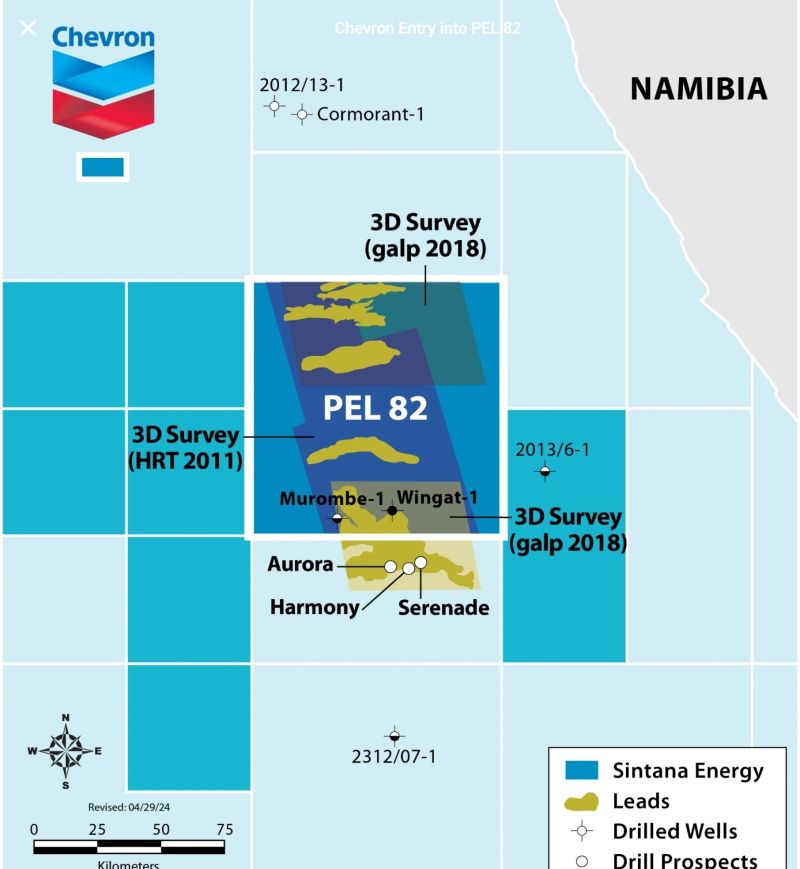
The deal, finalised with state oil company NAMCOR and local partner Custos Energy (each holding 10%), marks a strategic pivot for Chevron following its disappointing results in the Orange Basin earlier this year, where no commercial hydrocarbons were found.
Under the new arrangement, Chevron plans to drill up to 10 wells – five exploration and five appraisal – supported by a comprehensive seismic survey, well testing, and abandonment programme.
The company’s first planned target is the Gemsbok well, scheduled for drilling between 2026 and 2027.
While the Orange Basin has dominated headlines with recent major discoveries by TotalEnergies and Shell, Chevron’s move into the Walvis Basin reflects growing industry interest in diversifying Namibia’s offshore prospects.
The basin’s shallower waters and distinct geological structures present both lower operational risks and new exploration opportunities.
For Namibia, the renewed investment signals ongoing confidence from global oil majors despite mixed exploration results. Analysts say the activity could generate jobs, service contracts, and logistics demand across ports such as Walvis Bay and Lüderitz, deepening the country’s role in the regional energy supply chain.
If Chevron’s exploration proves successful, it could strengthen Namibia’s position as a rising energy hub – one capable not only of producing crude but also potentially anchoring refining and value-added operations within Africa.
However, experts warn that frontier drilling remains high-risk, with significant costs and environmental sensitivities. Civil society groups and regulators have urged Chevron and its partners to ensure transparent agreements, responsible exploration practices, and equitable benefit-sharing for Namibian communities.
Despite those challenges, Chevron’s latest move suggests the company – and the wider industry – remain convinced of Namibia’s long-term potential as one of Africa’s most promising new offshore frontiers.
